L1 Immigration Attorney Services
In today's global chess game of international commerce, the capacity to deploy qualified personnel where they're needed at the optimal time is a crucial advantage. For international companies, the L-1B visa serves as the specialist's gateway-a vital instrument for transferring professionals with unique skills to the United States. This visa designation is structured for personnel who maintain "specialized knowledge" that is vital to the company's operations, offerings, or services. However, the definition "specialized knowledge" represents one of the most intricate and thoroughly reviewed components in U.S. immigration law. This resource is intended to explain the L-1B visa, presenting a strategic roadmap for companies and employees looking to leverage this powerful opportunity. With the assistance of a seasoned L1 immigration attorney, the L-1B visa can create new possibilities for development and progress in the American market.
Main Insights
- L-1B visas serves as a temporary work permit for staff members with L-1B specialized knowledge that is critical to an organization's operations.
- It represents a crucial part of the multinational company transfer process, enabling enterprises to maximize their internal workforce for U.S. operations.
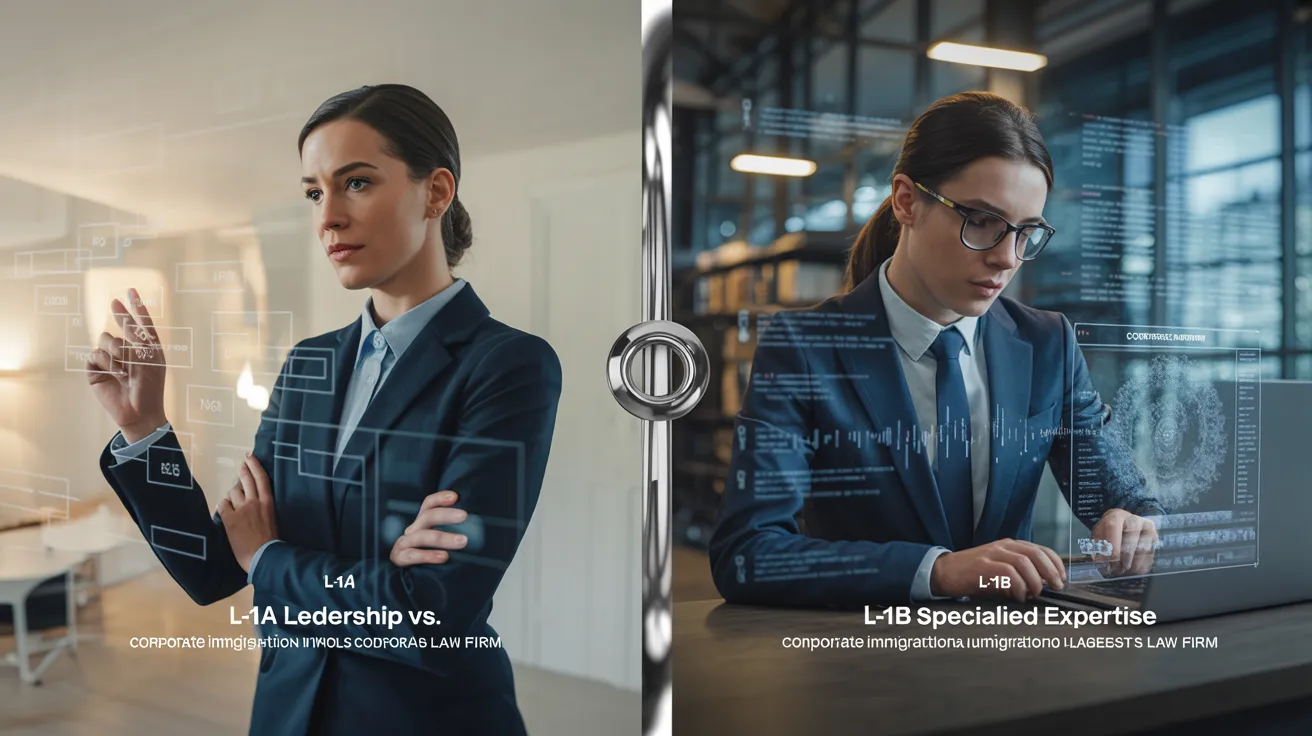
- Unlike the executive transfer visa (L-1A), the L-1B centers on an employee's specialized knowledge and capabilities instead of their management responsibilities.
- Establishing in-depth expertise is a substantial evidentiary threshold, making the guidance of an L1 visa lawyer essential for creating a effective application.
- A knowledgeable L1 immigration attorney is your best resource in navigating the challenges of L-1B visa processing, including responding to complex Requests for Evidence (RFEs).
- Although the L-1B includes a five-year duration, it can act as a stepping stone to a copyright, and an legal expert can guide you in developing a strategy for this long-term objective.
Understanding Global Business: A Guide to Multinational Company Transfers
The L-1 visa system operates as the backbone of global business, allowing the smooth movement of talent for a multinational company transfer. It allows organizations to relocate essential staff from their international operations to a parent, subsidiary, affiliate, or branch office in the United States. This intracompany transfer mechanism is vital for sustaining corporate culture, transferring institutional knowledge, and carrying out global business strategies. The L-1 visa is divided into two unique categories: the L-1A for executives and managers, and the L-1B for specialists with unique expertise. While both categories fulfill the broader goal of enabling international business, they have different eligibility criteria and strategic considerations. Understanding the intricacies of this program is essential for any business looking to establish its footprint in the U.S., and it's a journey best managed with the assistance of an experienced immigration lawyer.
The Essential Element of Your L-1B Case: Understanding L-1B Advanced Knowledge
The basis for any L-1B visa petition rests on one key, challenging, and frequently debated element: L-1B specialized knowledge. This concept is not easily defined, and its interpretation by U.S. Citizenship and Immigration Services (USCIS) has evolved over time. According to USCIS, specialized knowledge is defined as specific knowledge an employee has that is advanced and unique to the petitioning organization's operations, methodologies, technologies, processes, management practices, or other core aspects. It comprises knowledge that is not commonly found within the industry or that's difficult to convey to another individual without substantial expense or operational impact. Demonstrating the existence of specialized knowledge requires meeting a high evidentiary threshold. It necessitates a comprehensive and convincing showing that the employee's skills and expertise are genuinely distinctive, exclusive, and crucial to the company's U.S. operations. This is the point where the expertise of an L1 visa lawyer proves essential in crafting a persuasive and well-documented case.
Understanding the Executive Transfer L-1A Visa: A Complete Guide
To thoroughly grasp the distinct characteristics of the L-1B visa, it proves beneficial to compare it with its executive counterpart, the L-1A visa. The L-1A is an executive transfer visa created for executives and managers who will be directing the operations of the organization or a significant component. The emphasis of the L-1A is on the individual's senior-level managerial or executive duties and their ability to make decisions and direct the work of others. In contrast, the L-1B centers on the specialized nature of the individual's knowledge, independent of their position in the corporate hierarchy. While an L-1A beneficiary manages the team, the L-1B beneficiary is often the crucial technical expert or specialist on that team. Recognizing this difference is crucial for choosing the correct visa category and for developing a successful petition, as the documentation needs for each are substantially different.
Building the Unshakable Case: How Legal Experts Demonstrate Professional Expertise
Proving the existence of L-1B specialized knowledge combines artistic finesse with scientific rigor, and it requires the expertise of a experienced L1 visa lawyer. A successful petition is an unshakable case built on comprehensive conclusive evidence and strong legal justification. An experienced lawyer will work closely with the company and the employee to identify and articulate the unique expertise that distinguishes the worker. This involves a thorough analysis of the organization's unique methods, systems, and operational procedures. The lawyer will then gather a comprehensive set of documentation to support the claim, which could encompass proprietary documents, training manuals, project reports, and management endorsements. The objective is to present a clear and compelling picture for the USCIS adjudicator, proving that the candidate's skills is more than beneficial, but absolutely crucial to the U.S. operation's growth. This thorough documentation is the signature of a premier L1 immigration firm.
Navigating Success: A Step-by-Step L-1B Application Guide
Managing the L-1B application process is similar to using a detailed guide for success. With the support of an L1 immigration attorney, the process can be broken down into a series of straightforward phases. It commences with a thorough eligibility assessment of both the company and the employee. This is continued with the methodical preparation of the petition, which encompasses the assembling of all necessary documentation and the preparation of the legal arguments. Once the petition is lodged with USCIS, there is a phase of adjudication, during which the government reviews the case. If USCIS requires additional information, they will release a Request for Evidence (RFE), which must be addressed in a quick and detailed manner. Upon approval of the petition, the employee can then request their L-1B visa at a U.S. consulate or embassy abroad. The final step is the visa interview, after which the employee can arrive in the U.S. and initiate their assignment.
Navigating Immigration Complexity: How an L1 Attorney Serves as Your Guide
The United States immigration process constitutes a complex and often unforgiving bureaucracy. An L1 immigration attorney acts as your advocate, your guide, and your champion within this system. Their role extends beyond document submission; they offer strategic direction and to identify and address possible challenges. From beginning consultation through final visa determination, a seasoned legal professional will guide you, ensuring that your case is presented in the strongest possible light. They will guide you through the intricate regulations, ready you for immigration officer review, and respond effectively to any challenges that may arise. In a system where a single mistake or omission can lead to costly delays or even a denial, the value of a dedicated legal advocate cannot be overstated.
Navigating Challenges: RFEs and Denials
Receiving a Request for Evidence (RFE) or rejection on an L-1B petition can be a major setback, but it's not necessarily the end of the process. This marks a critical moment where the guidance of an L1 immigration attorney is particularly vital. An seasoned attorney will carefully review the RFE or denial notice to identify the government's reasoning and to determine the exact areas of concern. They will then work with you to formulate a strategy for handling the RFE or for contesting or refiling the case in the case of a denial. A thorough RFE response or appeal requires not just additional evidence, but also a convincing legal argument that directly addresses the government's concerns. With the right legal strategy, it is often possible to overcome these hurdles and achieve a favorable outcome.
The Blanket L-1: A Streamlined Option for Eligible Companies
When it comes to major international companies, the Blanket L-1 program delivers a straightforward and productive option for relocating employees to the United States. Once a company has an approved Blanket L petition, they can relocate employees, including those with L-1B specialized knowledge, without having to file a distinct petition with USCIS for each employee. Alternatively, the employee can submit their L-1B visa straight at a U.S. embassy or consulate abroad. This greatly minimizes paperwork and processing requirements. To qualify for the Blanket L program, a company must satisfy certain business size and activity requirements. An experienced L1 visa lawyer can advise a company on their qualification status for this program and can help with the completion and filing of the Blanket L petition.
Navigating Life in America: L-1B Status Privileges and Limitations
Life in the United States on an L-1B visa features a specific set of rights and limitations. The primary right is the permission to stay and be employed in the U.S. for the petitioning employer. L-1B visa holders can also bring their immediate family members with them on L-2 dependent visas. A notable benefit is that L-2 spouses are able to apply for work authorization, enabling them to work for any employer in the U.S. However, there are also restrictions. The L-1B visa has a limit of five years, and when this duration ends, the individual must generally depart the U.S. for at least one year before they can be eligible for a new L or H visa. It is also important to remember that the L-1B is a non-immigrant visa, and holders must preserve an intent to exit the U.S. upon the termination of their status.
Navigating the L-1B to copyright Process: A Specialist's Guide
While the L-1B visa is considered a temporary, non-immigrant visa, it can act as a valuable stepping stone from specialist to resident. For many L-1B holders, the ultimate goal is to secure permanent residency (a copyright) in the United States. Though the L-1B does not have a direct path to a copyright like the executive transfer visa (L-1A) provides, there are still possible pathways. An L-1B holder may be able to qualify for a copyright through the PERM labor certification process, where their employer supports them for permanent residency. In another scenario, if the L-1B holder advances to a managerial or executive position, they could become eligible to file for a copyright under the EB-1C category. An experienced L1 immigration attorney offers invaluable strategic guidance on the best pathway to a copyright considering the individual's unique circumstances and career trajectory.
Popular Questions
How does immigration law define L-1B specialized knowledge?
Understanding the legal parameters of L-1B specialized knowledge is complex and subject to interpretation by USCIS. This category refers to knowledge that is specialized and unique to the petitioning organization's products, services, research, equipment, techniques, management, or other interests. It must be knowledge that is not commonly held within the industry and that would be difficult to impart to another individual without significant expense or inconvenience. Demonstrating that a worker's expertise satisfies these requirements demands comprehensive evidence and an in-depth analysis of why their skills are unique and essential to the company. An L1 visa lawyer is vital for constructing a case that effectively demonstrates this.
What makes the L-1B visa distinct from the H-1B visa?
While both the L-1B and H-1B are non-immigrant work visas, but they have several key differences. The L-1B visa is specifically for intracompany transfers, requiring the employee to have worked with a related foreign entity for at least one year before transferring to the U.S. The H-1B specifically serves specialty occupation workers and does not necessitate prior employment with a related foreign company. The H-1B uses a lottery system due to annual numerical limits, but the L-1B has no annual cap. For the L-1B, specialized company-specific knowledge is essential, whereas the H-1B demands a bachelor's degree or its equivalent in a specific field.
Am I allowed to transfer to a different employer on an L-1B visa?
No, the L-1B visa is employer-specific. Your work authorization is limited to the company that filed your L-1B petition. Changing employers requires a new company to file a separate visa petition in your name, such as an H-1B or another applicable category. Your L-1B status cannot be transferred to a different, unaffiliated employer. This represents a significant distinction from other visa categories and is crucial for L-1B visa holders to understand.
What follows an L-1B petition denial?
In the event your L-1B petition receives a denial, your L1 immigration attorney will thoroughly examine the denial notice to identify the here basis for the decision. Based on the circumstances, you could explore several options. You may be able to file a motion to reopen or reconsider the case if you think there was a legal error in the decision. Otherwise, you could file an appeal with the Administrative Appeals Office (AAO). In some cases, the most effective solution could be to refile the petition with additional evidence that responds to the issues raised in the denial. An experienced attorney can guide you decide on the best course of action.
Is it possible to transition from an L-1B copyright a copyright?
Yes, it is possible to secure a copyright while on an L-1B visa, however there is no direct path. The most common route is through employer sponsorship via the PERM labor certification process. This involves the employer demonstrating that there are no qualified U.S. workers qualified for the position. Another potential pathway is if the L-1B employee moves into a managerial or executive position within the company. When this happens, they may become eligible to apply for a copyright under the EB-1C category for multinational managers and executives, which doesn't need a labor certification. A knowledgeable L1 visa lawyer can provide strategic advice on the optimal long-term immigration approach.